Conceive Plus vs Pre-Seed: The Ultimate Fertility Lubricant Comparison


If you are trying to conceive (TTC), you have almost certainly encountered two names more than any other in the fertility lubricant space: Conceive Plus and Pre-Seed. Both are marketed specifically to couples trying to get pregnant. Both claim to be sperm-friendly. Both carry FDA clearance. But they are not identical products — and if you are deciding which to use during your fertile window, the differences matter.
This guide provides an honest, science-backed comparison of conceive plus vs preseed — covering formulation, clinical evidence, ease of use, price, and what the fertility science actually says about which product best supports conception. We will also explain what makes a lubricant truly fertility-friendly, so you can make the most informed choice for your journey.
Why Your Choice of Lubricant Matters When Trying to Conceive
Before comparing these two products, it is worth understanding why this category exists at all. The answer lies in what most standard lubricants do to sperm.
Research published in Fertility and Sterility — the leading journal in reproductive medicine — has demonstrated that many commercially available personal lubricants significantly impair sperm motility within minutes of exposure. Products including KY Jelly, Astroglide, and saliva have all been shown to reduce progressive sperm motility by 60–90% in laboratory conditions. Even natural alternatives like olive oil and canola oil show negative effects on sperm function.
The reasons are multiple. Most standard lubricants have a pH that is far too acidic for sperm survival (optimal sperm function requires pH 7.0–8.5, while many lubricants register pH 3.8–4.5). Their osmolality (particle concentration) is also often mismatched with seminal fluid, causing osmotic stress that damages sperm cell membranes. And they typically contain preservatives and compounds that are directly toxic to sperm.
For couples who are using lubricant during their fertile window — which many couples do, since cervical mucus can be insufficient, and intercourse anxiety during TTC cycles is real — choosing a product that does not harm sperm is genuinely important.
Support Every Attempt with Conceive Plus
Our fertility-friendly lubricant is scientifically formulated to support sperm motility during your fertile window. Unlike standard lubricants that can harm sperm, Conceive Plus contains calcium and magnesium ions naturally found in the female reproductive tract — creating the optimal environment for sperm survival and motility.
Conceive Plus: Formulation and Mechanism
Conceive Plus was developed specifically for the TTC population by Sasmar Pharmaceuticals and has been available to fertility clinics and consumers since 2009. It is currently used in fertility clinics across North America, Europe, Australia, and Asia — and carries FDA clearance as a Class II medical device.
What distinguishes Conceive Plus from most other fertility lubricants — including Pre-Seed — is its ionic formulation. Conceive Plus contains calcium and magnesium ions that are naturally present in human fallopian tube fluid and cervical mucus. These minerals play a documented role in sperm capacitation — the biological process by which sperm acquire the ability to penetrate and fertilise an egg.
Key formulation features of Conceive Plus:
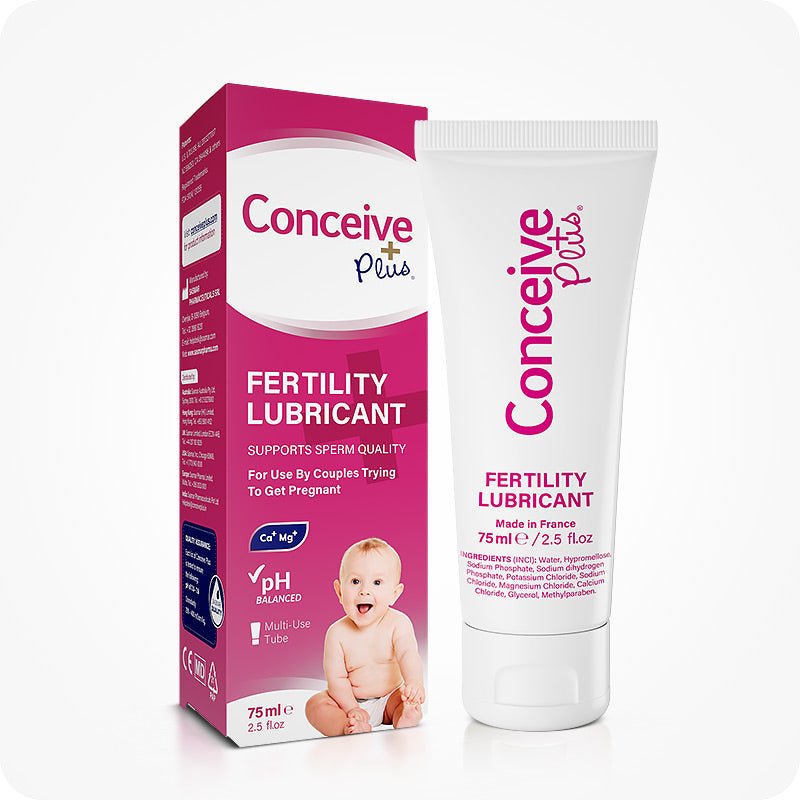
- pH 7.0–7.5: Matched to seminal fluid and the cervical environment during ovulation
- Iso-osmotic formulation: Osmolality matched to human semen (approximately 280–380 mOsm/kg), preventing osmotic damage to sperm
- Calcium and magnesium ions: Support sperm function and capacitation in a way that plain buffered lubricants do not
- No spermicidal agents: No nonoxynol-9 or other compounds known to harm sperm
- Paraben-free formula: Minimises potential hormonal disruption
In clinical studies, Conceive Plus has been shown to maintain sperm motility at levels statistically indistinguishable from the control condition (no lubricant). A study published in Fertility and Sterility found that Conceive Plus did not significantly impair sperm motility, viability, or DNA integrity, making it suitable for use during timed intercourse and IUI cycles.
Pre-Seed: Formulation and Mechanism
Pre-Seed (manufactured by First Response / Church & Dwight) was one of the first fertility-specific lubricants on the market, receiving FDA clearance in 2002. It was developed by Dr Joanna Ellington, a reproductive physiologist, and its formulation reflects genuine scientific thought about what sperm need to survive in a lubricant environment.
Pre-Seed formulation features:
- pH 7.2–7.4: Similarly matched to seminal fluid
- Iso-osmotic: Osmolality in the appropriate range for sperm
- Hydroxyethylcellulose base: Creates a water-based gel that mimics the consistency of natural cervical mucus
- No spermicidal agents: Safe for sperm
Pre-Seed has been validated in similar studies and is widely recommended by fertility specialists as a sperm-safe lubricant. Like Conceive Plus, it does not significantly impair sperm motility versus the no-lubricant control.
Head-to-Head: Conceive Plus vs Pre-Seed
Both products are scientifically sound and represent a substantial upgrade over standard personal lubricants for couples trying to conceive. The differences are more nuanced — but they are meaningful:
Ionic composition: Conceive Plus includes calcium and magnesium ions; Pre-Seed does not. This is the most clinically significant formulation difference. Calcium is required for the acrosome reaction — the process by which a sperm releases enzymes to penetrate the egg's outer membrane. Magnesium supports sperm mitochondrial function, which drives the flagellar motion that propels sperm. By including these ions, Conceive Plus more closely mimics the natural environment of the female reproductive tract, potentially offering an active benefit beyond simply being non-harmful to sperm.
Clinical evidence: Both products have been validated in peer-reviewed studies. Conceive Plus has been specifically studied in clinical fertility settings and has a longer track record of use in IUI and timed intercourse protocols in fertility clinics.
Format options: Conceive Plus offers both pre-filled applicators (4g each, similar to Pre-Seed) and a 75ml tube for external use. Pre-Seed is primarily available in tubes with included applicators. The pre-filled Conceive Plus applicators are single-use and pre-measured, which some users find more convenient and hygienic.
Texture and sensation: Both products have a gel-like consistency designed to mimic cervical mucus. Conceive Plus is generally described as slightly thinner and more natural-feeling; Pre-Seed is slightly thicker. This is largely a matter of personal preference.
Price: Both products are similarly priced in most markets. Conceive Plus is available in multiple formats and sizes, which can offer better value per application when buying the larger tube.
Support Every Attempt with Conceive Plus
Our fertility-friendly lubricant is scientifically formulated to support sperm motility during your fertile window. Unlike standard lubricants that can harm sperm, Conceive Plus contains calcium and magnesium ions naturally found in the female reproductive tract — creating the optimal environment for sperm survival and motility.
What the Research Says: Which Product Performs Better?
A 2012 study published in Fertility and Sterility directly compared multiple lubricants including Conceive Plus and Pre-Seed against a no-lubricant control. Key findings:
- Both Conceive Plus and Pre-Seed maintained sperm motility at levels not significantly different from the control (no lubricant)
- Both showed significantly better sperm motility preservation than standard lubricants (KY Jelly, Astroglide, baby oil)
- The calcium and magnesium content of Conceive Plus was noted as a potential additional benefit for sperm function, though further clinical studies are needed to quantify this precisely in vivo
A 2014 study from Egypt specifically examining Conceive Plus in IUI cycles found that cycles using Conceive Plus had comparable pregnancy rates to cycles using no lubricant, confirming its safety for use in assisted reproduction. This type of clinical validation — being used in IUI cycles — is an important marker of clinical trust.
How to Use Conceive Plus Most Effectively
For couples trying to conceive, the best strategy is to identify your fertile window (the five to six days ending on ovulation day) using ovulation predictor kits (OPKs), basal body temperature tracking, or monitoring cervical mucus changes — then use Conceive Plus on the days most likely to result in conception.
Using pre-filled applicators: Insert the applicator 5–10 minutes before intercourse. The product is delivered internally, close to the cervix, where it can maximise the supportive environment for sperm that have already entered the cervical canal. Each applicator contains 4g — a sufficient amount for internal application without excess.
Using the tube: Apply externally as needed during foreplay or intercourse. This approach is suitable for couples whose primary concern is comfort rather than internal coverage, or for those who prefer to use lubricant more spontaneously.
Not just for ovulation day: Because sperm can survive in the female reproductive tract for up to five days when cervical mucus is optimal, conception can occur from intercourse on any of the five to six days before ovulation. Using Conceive Plus on any of these days is appropriate.
Fertility Lubricants as Part of a Broader TTC Strategy
Choosing a fertility-friendly lubricant is an important step, but it is one element of a broader conception strategy. Other evidence-based interventions include:
- Timing intercourse correctly: Focus on the three to four days before and including ovulation. Every-other-day intercourse throughout the fertile window maintains sperm quality while ensuring coverage of all peak days.
- Women's fertility supplements: Methylfolate (the bioavailable form of folate), myo-inositol, CoQ10, vitamin D3, and zinc all have evidence for supporting egg quality and ovulatory function. Start at least three months before trying to conceive.
- Men's fertility support: Sperm take approximately 74 days to develop. Supplementing with L-carnitine, CoQ10, zinc, selenium, and vitamin C during the three months before active trying can measurably improve sperm parameters.
- Reduce exposure to toxins: Heat (laptops, hot baths, cycling), smoking, excess alcohol, and endocrine-disrupting chemicals all impair sperm quality. Reducing exposure for at least three months has measurable impact.
- Support cervical mucus: Adequate hydration, evening primrose oil (in the follicular phase), and avoiding antihistamines during your fertile window all support the optimal cervical environment for sperm survival and motility.
Frequently Asked Questions
Q: Is Conceive Plus better than Pre-Seed?
Both are high-quality fertility lubricants that are sperm-safe and FDA cleared. Conceive Plus has the additional advantage of calcium and magnesium ions that support sperm function, making it the preferred choice in many fertility clinics worldwide.
Q: Can Conceive Plus help me get pregnant faster?
Conceive Plus is designed not to impair sperm function — it is not a fertility treatment. However, by using a sperm-safe lubricant during your fertile window instead of a standard lubricant that could reduce sperm motility by 60–90%, you give conception the best possible chance each cycle.
Q: How do I use Conceive Plus applicators?
Insert the applicator vaginally 5–10 minutes before intercourse during your fertile window. Each pre-filled applicator contains 4g of gel. Conceive Plus is also available as a 75ml tube for external application.
Q: Is Conceive Plus safe to use every month?
Yes. Conceive Plus contains no spermicidal agents, no parabens, and no compounds known to be harmful to sperm or vaginal tissue. It is designed for regular use during the TTC journey.
Q: Does Conceive Plus work for IUI?
Yes. Conceive Plus is used in fertility clinics for IUI cycles and has been clinically validated for this use. It is one of the few lubricants approved for use in assisted reproduction settings.
Q: Where can I buy Conceive Plus in the US?
Conceive Plus is available at conceiveplus.com, as well as major pharmacies and online retailers. The pre-filled applicators and tube formats are both available.
The verdict on conceive plus vs preseed: both are excellent choices and a significant upgrade from standard lubricants. If the additional ionic support from calcium and magnesium resonates with the science — and the clinical use of Conceive Plus in IUI protocols suggests it should — Conceive Plus is the more advanced formulation. Either way, switching from a standard lubricant to a fertility-specific product is one of the simplest, lowest-cost changes couples trying to conceive can make to support every attempt.