Lubricant for IVF: What You Need to Know Before, During, and After Treatment


Lubricant for IVF: What You Need to Know Before, During, and After Treatment
When you are going through IVF, every small decision feels enormous. You scrutinise your diet, your supplements, your stress levels — and rightly so. But one product that couples frequently overlook until the last minute is lubricant for IVF. Whether you are trying naturally alongside a treatment cycle, managing vaginal dryness caused by hormonal medications, or simply looking for comfort during an already demanding journey, choosing the right lubricant matters more than most people realise.
This guide covers everything you need to know about using a lubricant for IVF patients: why standard lubricants can be harmful, what makes a fertility-safe formula different, and how Conceive Plus supports couples navigating assisted reproduction.
Why IVF Patients Should Think Carefully About Lubricant
IVF is an intensive medical process. Hormonal stimulation medications, egg retrieval procedures, progesterone suppositories, and the general emotional weight of treatment can all contribute to vaginal dryness and discomfort during intercourse. Research published in Fertility and Sterility found that up to 46 per cent of women undergoing fertility treatment reported significant vaginal dryness during treatment cycles.
The instinct many couples have is to reach for a standard over-the-counter lubricant. This is where problems can arise. Conventional lubricants — including popular brands like KY Jelly and Astroglide — have been shown in multiple studies to impair sperm motility, viability, and DNA integrity. A landmark study from the University of California found that many commercial lubricants reduced sperm motility by up to 60 per cent within 30 minutes of exposure.
For couples using lubricant for IVF, particularly those attempting natural conception in cycles between transfers, or those whose male partner provides a semen sample at home, this damage to sperm is clinically relevant.
Lubricant for IVF: What Does "Fertility Safe" Actually Mean?
The phrase "fertility-safe" or "sperm-friendly" is not marketing language — it refers to specific measurable characteristics that determine whether a lubricant will harm or support sperm. When selecting a fertility lubricant IVF patients should look for:
- pH balance: Healthy vaginal pH during the fertile window sits between 7.0 and 8.5. Sperm survive best in this range. Standard lubricants are often formulated to match typical vaginal pH (3.8–4.5), which is hostile to sperm. A true IVF lubricant safe for sperm must match the sperm-friendly pH, not the resting vaginal pH.
- Osmolality: Measured in mOsm/kg, osmolality describes the concentration of dissolved particles in a solution. The World Health Organization recommends lubricants used in a fertility context have osmolality below 380 mOsm/kg. High-osmolality products draw water out of sperm cells through osmosis, causing irreversible damage.
- Absence of toxic ingredients: Parabens, glycerin, propylene glycol, nonoxynol-9, and certain preservatives all appear in common lubricants and are toxic to sperm.
- Mineral ions: Sperm require calcium and magnesium ions to complete capacitation — the biochemical process that allows them to penetrate an egg. Some advanced fertility lubricants include these ions to actively support sperm function.
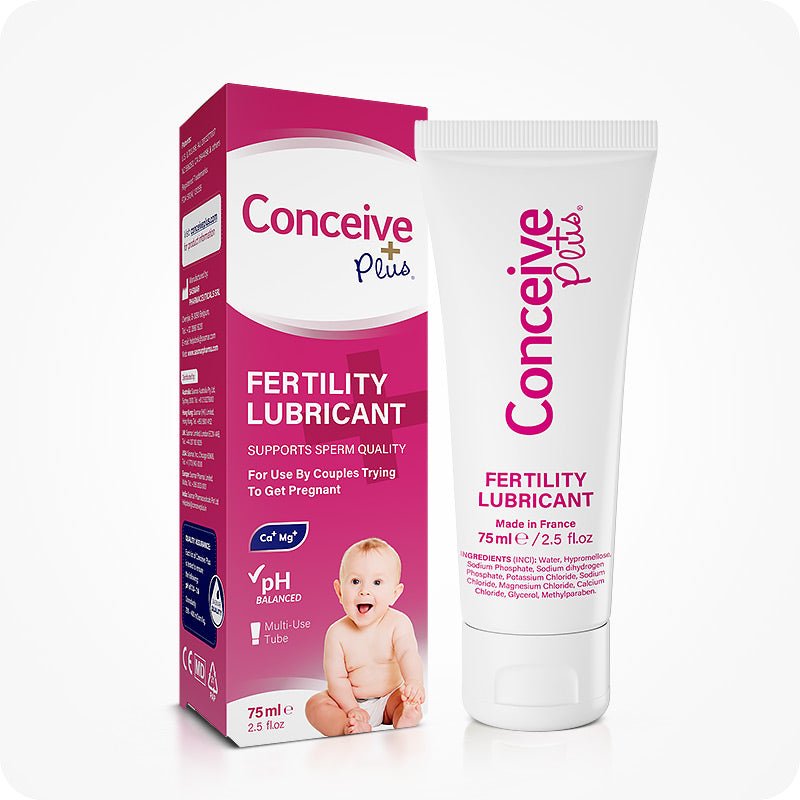
Conceive Plus checks every one of these boxes. Its formula is pH balanced to 7.0–8.5, its osmolality aligns with WHO guidelines, and it contains the calcium and magnesium ions that support sperm capacitation. For anyone needing a lubricant for IVF that is genuinely safe and supportive, Conceive Plus is the clinical-grade choice.
Conceive Plus vs Pre-Seed: Which Is Better for IVF Patients?
Couples researching fertility lubricant IVF options will inevitably compare Conceive Plus and Pre-Seed, the two most prominent sperm-friendly lubricants on the market. Here is an honest, data-driven comparison:
Conceive Plus was developed by reproductive endocrinologists and is formulated with calcium and magnesium ions that mimic natural fertile cervical mucus. It is used in IVF clinics and fertility practices in over 60 countries. Its pH of 7.0–8.5 and controlled osmolality mean it supports sperm from application through to fertilisation.
Pre-Seed is an isotonic lubricant that also avoids the most toxic standard lubricant ingredients. It is water-based and pH buffered. However, it does not contain the mineral ions found in Conceive Plus, meaning it mimics cervical mucus structurally but not biochemically.
For TTC during IVF, or for couples timing intercourse to coincide with natural cycles alongside treatment, the biochemical support offered by Conceive Plus's calcium and magnesium content gives it a meaningful advantage. When every element of your fertility journey is being optimised, choosing the lubricant that actively supports sperm capacitation rather than simply avoiding harm makes clinical sense.
🌿 Trusted by fertility clinics worldwide
Conceive Plus is the only lubricant formulated with calcium and magnesium ions to actively support sperm function during your IVF journey.
Shop Conceive Plus Fertility Lubricants →
When During IVF Can You Use Lubricant?
IVF involves distinct phases, and the role of lubricant for IVF patients varies at each stage:
Stimulation Phase
During ovarian stimulation, intercourse is often avoided to reduce the risk of ovarian hyperstimulation syndrome (OHSS) and to protect follicles. Many clinics advise abstaining. However, vaginal dryness from medications can still cause discomfort, and a fertility-safe lubricant can be used for personal comfort without sperm concerns at this stage.
Trigger Shot and Retrieval
Intercourse is typically not recommended in the 24–48 hours before egg retrieval. However, if your partner is providing a semen sample at home for transport to the clinic, using a sperm friendly lubricant IVF-compatible product during collection can help. Standard lubricants used at collection can compromise sperm quality in the sample. Conceive Plus or no lubricant at all are the appropriate choices here.
Transfer and Two-Week Wait
Some clinics recommend pelvic rest after embryo transfer. Others permit gentle intercourse, arguing that the natural uterine contractions from orgasm may actually aid implantation. If intercourse is approved by your clinic, using a fertility-safe lubricant is important. Conceive Plus will not introduce any chemicals that could interfere with the implantation environment.
Between Cycles
For couples attempting natural conception between IVF cycles — which many clinics now encourage — timing intercourse with ovulation and using a lubricant for IVF patients becomes directly relevant to fertility outcomes. Conceive Plus supports this window fully.
The Science Behind Conceive Plus for IVF Patients
What sets Conceive Plus apart for the IVF audience is not just what it avoids (toxic ingredients), but what it actively provides. The inclusion of calcium and magnesium ions in the Conceive Plus formula is scientifically significant.
Sperm capacitation — the final maturation process that allows sperm to fertilise an egg — is calcium-dependent. Research published in the Journal of Cell Biology demonstrated that calcium influx is essential for the acrosome reaction, the event that allows a sperm to penetrate the zona pellucida of an egg. Without adequate calcium, even morphologically perfect sperm may fail to fertilise.
Magnesium plays a complementary role in sperm metabolism, supporting the energy production pathways (specifically ATP synthesis) that power sperm motility. Studies in Human Reproduction have shown that magnesium deficiency correlates with reduced sperm motility and male factor infertility.
By including both ions in its formula, Conceive Plus does more than simply avoid harm. It creates the biochemical environment that sperm need to perform their best — a meaningful advantage for anyone using fertility lubricant IVF-compatible products.
Vaginal Dryness During IVF: Why It Happens and How Conceive Plus Helps
Vaginal dryness is an almost universal side effect of IVF medications. The mechanisms behind it include:
- GnRH agonists and antagonists (like Lupron, Cetrotide) suppress estrogen production, which dramatically reduces natural vaginal lubrication.
- Progesterone supplementation (suppositories, gels, or injections) used after transfer alters vaginal environment and can cause dryness and irritation.
- Psychological stress of the treatment itself activates the sympathetic nervous system, reducing arousal responses including natural lubrication.
- Reduced intercourse frequency during treatment means less natural arousal-based lubrication when couples do have sex.
Conceive Plus addresses the dryness itself with a formula that provides immediate lubrication while maintaining a sperm-supportive environment. For the many women who experience discomfort during intercourse at any point in an IVF cycle, Conceive Plus offers a solution that neither compromises their fertility journey nor forces a choice between comfort and conception.
What IVF Clinics Say About Lubricants
The position of leading fertility clinics on lubricants has shifted significantly over the past decade. Where previously clinics simply advised patients to avoid lubricants entirely, the emergence of validated sperm-safe formulas has changed the conversation.
Reproductive endocrinologists at major fertility centers including CCRM, RMA, and Shady Grove Fertility now recommend sperm-friendly lubricants for appropriate use cases during fertility treatment. The key criterion they cite is validation against WHO semen analysis standards — the same standard that Conceive Plus meets.
Many clinics specifically recommend Conceive Plus by name, citing its dual benefit of sperm safety and active ion supplementation. It is used in clinical settings in the United States, United Kingdom, Australia, and throughout Europe.
If you are unsure whether IVF lubricant safe for your protocol is appropriate at a given stage, always check with your reproductive endocrinologist or nurse coordinator. The answer will almost always be "yes, as long as it is a validated sperm-safe product" — and Conceive Plus fits that description exactly.
🌿 Support every stage of your IVF journey
Conceive Plus is clinician-recommended, WHO-guidelines aligned, and formulated with fertility-supporting calcium and magnesium ions. Used by IVF patients in over 60 countries.
Get Conceive Plus for Your IVF Cycle →
Practical Tips for Using Lubricant During IVF
- Always check with your clinic first. While sperm-safe lubricants are generally approved, specific protocol phases may have restrictions. Get clarity at your first consultation.
- Use sparingly. Even the best lubricant should be used in modest amounts — a small pea-sized amount inside and at the opening of the vagina is sufficient.
- Avoid warming or cooling lubricants. These products almost universally contain ingredients that can harm sperm. Stick to standard Conceive Plus formula.
- Do not use lubricant as a supplement for cervical mucus. Conceive Plus supports sperm but does not replace the many functions of natural fertile cervical mucus, including filtering abnormal sperm and providing an immunological role.
- Time use correctly. Apply lubricant close to intercourse, not hours before. Conceive Plus is designed for immediate use and does not require advance preparation.
- Check expiry dates. IVF treatments can stretch over many months. Check that your Conceive Plus is within its use-by date, as the pH and ion content can degrade over time.
Frequently Asked Questions: Lubricant for IVF
Can I use lubricant during an IVF cycle?
Yes, with the right product. Standard lubricants are harmful to sperm and should be avoided. A validated sperm-safe lubricant like Conceive Plus is designed to be used safely during fertility treatment. Always confirm with your clinic about timing relative to your protocol stage.
Is Conceive Plus safe for IVF patients?
Yes. Conceive Plus is a clinician-developed fertility lubricant formulated specifically for couples trying to conceive, including those undergoing IVF. It has been validated to meet WHO semen analysis standards and is used in IVF clinics worldwide.
Can lubricant affect IVF outcomes?
Directly, lubricant does not affect IVF outcomes (the fertilisation happens in the lab). However, if you are having intercourse alongside treatment, standard lubricants can damage sperm quality. For natural conception attempts between cycles, using a fertility-safe lubricant is directly relevant.
Can I use lubricant when my partner provides a semen sample at home?
If your partner needs assistance producing a sample at home, a sperm-safe lubricant like Conceive Plus can be used. Standard lubricants should absolutely be avoided, as they can compromise the sample. Some clinics provide sterile, lubricant-free collection aids — ask your clinic what they recommend.
Does lubricant affect embryo implantation?
There is no evidence that using a fertility-safe lubricant affects embryo implantation. If intercourse is approved by your clinic after transfer, Conceive Plus will not introduce chemicals that interfere with the implantation environment.
Can I use Conceive Plus during the two-week wait?
Yes, if your clinic permits intercourse during the two-week wait (some do, some don't based on the individual protocol). Conceive Plus is safe to use during this period and will not negatively affect the hormonal or physical environment required for implantation.
Is Conceive Plus better than Pre-Seed for IVF?
Both are sperm-safe and far superior to standard lubricants. Conceive Plus has the added benefit of calcium and magnesium ions that support sperm capacitation — the biochemical maturation sperm need to fertilise an egg. For couples maximising every element of their fertility journey, this active support gives Conceive Plus an edge.
What lubricants should IVF patients avoid?
Avoid KY Jelly, Astroglide, Vaseline, coconut oil, saliva, and any lubricant not specifically validated as sperm-safe. These products contain ingredients or have pH/osmolality levels that damage sperm within minutes of contact.
How should I apply Conceive Plus during IVF treatment?
Apply a small amount (the applicators included in some Conceive Plus packs are ideal) to the vaginal opening and internally if needed. Use immediately before intercourse. Do not use it as a daily moisturiser unless it is formulated for that purpose — the standard Conceive Plus gel is designed for use during intercourse.
Can Conceive Plus help with vaginal dryness from IVF medications?
Yes. The hormonal suppression and progesterone supplementation used in IVF commonly cause vaginal dryness and discomfort. Conceive Plus provides effective lubrication while maintaining a sperm-friendly environment — unlike standard vaginal moisturisers, which may not be appropriate if you are also having intercourse.
Going through IVF is one of the most demanding journeys a couple can take together. Every decision — including something as seemingly small as choosing a lubricant — deserves the same care and evidence-based thinking you bring to your treatment protocol. Conceive Plus is formulated to be there for you at every stage: supporting comfort, protecting sperm where it matters, and providing the biochemical environment that gives every attempt its best chance.