How to Choose a Fertility Lubricant: 5 Questions to Ask Before You Buy


How to Choose a Fertility Lubricant: 5 Questions to Ask Before You Buy
When you're trying to conceive, you scrutinise every variable — diet, timing, supplements, stress. Yet many couples overlook one surprisingly important factor: the lubricant they use during intercourse. Learning how to choose a fertility lubricant correctly could be the difference between inadvertently harming sperm and actively supporting your chances of conception.
The lubricant market is flooded with products that claim to be "natural," "gentle," or even "fertility-friendly." But not all of those claims hold up to scientific scrutiny. This guide gives you five essential questions to ask before you buy — backed by clinical research and reproductive science. By the end, you'll know exactly what to look for, what to avoid, and why Conceive Plus is the fertility lubricant that answers yes to every single question.
Why Does Lubricant Choice Matter for Conception?
Before diving into the five questions, it's worth understanding the biology at stake. Sperm are fragile cells that must travel from the vagina, through the cervix, and into the fallopian tube to fertilise an egg. That journey takes anywhere from 30 minutes to several hours, and every element of the vaginal environment affects sperm survival.
Research published in Fertility and Sterility (Sandhu et al.) demonstrated that common personal lubricants — including KY Jelly, Astroglide, and olive oil — significantly impaired sperm motility within minutes of exposure. The damage occurs through several mechanisms:
- Osmotic shock — lubricants with wrong osmolality cause water to rush into or out of sperm cells, rupturing membranes
- pH disruption — sperm function optimally at pH 7.2–8.0; acidic lubricants stun and immobilise them
- Physical barrier effect — thick, dense lubricants physically impede sperm motility and forward progression
- Ingredient toxicity — preservatives like parabens and some moisturisers directly damage sperm DNA
A 2014 study found that up to 82% of couples experiencing fertility challenges were using lubricants that harmed sperm — often without knowing it. Choosing the right fertility lubricant is not a minor detail. It's a foundational part of your conception strategy.
Question 1: Is the pH Compatible With Sperm Survival?
Ready to Choose the Right Fertility Lubricant?
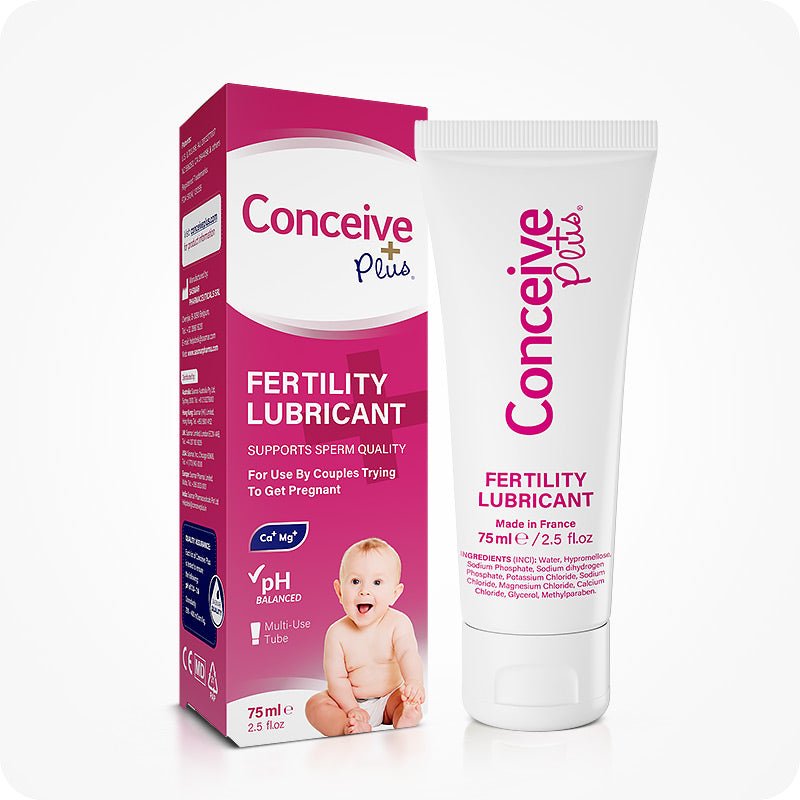
Conceive Plus answers yes to all 5 questions — pH-balanced, sperm-safe, clinically tested, and formulated with calcium and magnesium ions to support fertilisation.
Shop Conceive Plus Lubricants →When you're learning how to choose a fertility lubricant, pH is the first variable to examine. The vaginal pH varies significantly across the menstrual cycle. During the fertile window, cervical mucus naturally becomes more alkaline — typically reaching pH 7.0–8.5 — to welcome and protect sperm. This shift is one of nature's most elegant fertility signals.
The problem: most standard lubricants have a pH between 3.8 and 5.5, mirroring normal vaginal acidity. This makes them comfortable to use outside of ovulation but creates a hostile environment for sperm during the fertile window. Sperm motility drops sharply below pH 6.0, and at pH 4.5 — common in many popular lubricants — sperm can be immobilised within seconds.
What to look for: A fertility lubricant should have a pH between 7.0 and 8.5 — matching the fertile cervical mucus environment, not the standard vaginal environment.
Conceive Plus is formulated at pH 7.2–8.0, directly mirroring the alkaline conditions that naturally occur during your fertile window. This is one of the core reasons Conceive Plus is recommended by fertility specialists and used in IVF clinics globally.
Question 2: Is the Osmolality Appropriate for Sperm Cells?
Osmolality is a measure of solute concentration — in simple terms, how "salty" or "concentrated" a fluid is. This matters enormously for sperm because cell membranes are semi-permeable. When a sperm cell contacts a fluid with very different osmolality, water rushes across the membrane to equalise concentrations, often fatally distorting or rupturing the cell.
The World Health Organisation (WHO) recommends that lubricants intended for fertility should have osmolality between 280–380 mOsm/kg — consistent with seminal plasma and compatible with sperm viability. Many commercial lubricants measure between 600 and 1200 mOsm/kg, creating osmotic stress that kills sperm rapidly.
A landmark 2012 study in Fertility and Sterility tested eight popular lubricants and found all eight caused statistically significant reductions in sperm motility within 30 minutes. Osmolality mismatch was identified as a primary mechanism.
What to look for: ISO 29948:2009 certification or a stated osmolality of 280–380 mOsm/kg.
Conceive Plus is ISO 29948-compliant, formulated at an osmolality that is isotonic to seminal plasma. Sperm cells exposed to Conceive Plus maintain the same survival and motility rates as sperm in control conditions — a claim few lubricants can make.
Question 3: Does It Contain Sperm-Toxic Ingredients?
Reading a lubricant ingredient list can feel like decoding chemistry homework. But several common ingredients have been specifically shown to harm sperm, and knowing which ones to avoid is essential when figuring out how to choose a fertility lubricant.
Avoid these ingredients:
- Glycerol/Glycerin at high concentrations — creates hyperosmotic conditions
- Propylene glycol — shown to reduce sperm motility by up to 60% in vitro
- Nonoxynol-9 (N-9) — a spermicide; any lubricant containing this is incompatible with TTC
- Parabens (methylparaben, propylparaben) — linked to endocrine disruption and sperm DNA damage
- Chlorhexidine — an antimicrobial that damages both sperm and beneficial vaginal bacteria
- Petroleum-based ingredients — disrupt vaginal microbiome and may interfere with cervical mucus
Alarmingly, several lubricants marketed as "natural" or "organic" still contain glycerol, propylene glycol, or parabens. The label "natural" has no regulatory definition and offers no guarantee of sperm safety.
What to look for: A clean ingredient list free from the above, ideally with FDA 510(k) clearance as a medical device — which requires documented evidence that the product does not harm sperm.
Conceive Plus is FDA 510(k)-cleared, CE-marked, and TGA-registered. Its formula is free from spermicides, parabens, and high-concentration glycerol. Instead, it uses a hydroxyethylcellulose base — the same polymer used in artificial cervical mucus studies — to mimic the lubricating properties of natural fertile-quality cervical mucus.
Question 4: Does It Support Sperm Function — Not Just Avoid Harming It?
This is where truly advanced fertility lubricants distinguish themselves from the merely "sperm-safe" category. Avoiding harm is the baseline. Actively supporting sperm function is the next level.
Research has identified that calcium and magnesium ions play a critical role in sperm capacitation — the process by which sperm develop the ability to penetrate and fertilise an egg. This biochemical maturation occurs in the female reproductive tract and is mediated partly by ionic interactions. Sperm require specific calcium influx to initiate the acrosome reaction (the enzyme release needed to penetrate the egg's zona pellucida), and magnesium plays a complementary regulatory role.
A 2013 study in Human Reproduction demonstrated that lubricants supplemented with physiological concentrations of calcium and magnesium ions improved sperm motility parameters compared to lubricants without them. This is the science behind what makes one fertility lubricant genuinely superior to another.
What to look for: A formula that includes calcium and magnesium ions at physiologically relevant concentrations — not just a blank carrier that avoids spermicidal ingredients.
This is one of the most clinically significant differentiators for Conceive Plus. Its proprietary formula includes calcium and magnesium ions at concentrations found in fertile cervical mucus, actively supporting sperm capacitation — the biological step that immediately precedes fertilisation.
Conceive Plus vs Pre-Seed: Which Is the Better Fertility Lubricant?
No guide on how to choose a fertility lubricant would be complete without addressing the most common comparison: Conceive Plus vs Pre-Seed. Both products are marketed as sperm-friendly and are frequently discussed in trying-to-conceive communities. Here's how they compare across the five questions:
| Criteria | Conceive Plus | Pre-Seed |
|---|---|---|
| pH range | 7.2–8.0 ✅ | 7.1–7.6 ✅ |
| Osmolality | ISO 29948 compliant ✅ | Compatible ✅ |
| Calcium & Magnesium Ions | Yes — proprietary blend ✅ | No ❌ |
| FDA 510(k) Cleared | Yes ✅ | Yes ✅ |
| Spermicide-free | Yes ✅ | Yes ✅ |
| Available formats | Tube + Pre-filled applicators ✅ | Tube + Applicators ✅ |
| Used in IVF clinics globally | Yes ✅ | Limited ❌ |
The key differentiator is clear: Conceive Plus is the only fertility lubricant that contains calcium and magnesium ions — directly supporting sperm capacitation in a way that Pre-Seed and other alternatives do not. For couples who want a lubricant that goes beyond simply avoiding harm and actively supports conception biology, Conceive Plus is the scientifically superior choice.
Question 5: Is It Clinically Tested and Professionally Recommended?
The final question cuts through marketing language. Fertility is too important to trust to unverified claims. When choosing a fertility lubricant, look for:
- Peer-reviewed clinical data demonstrating sperm motility is maintained
- Regulatory clearance — FDA 510(k), CE marking, TGA registration (Australia), or equivalent
- Recommendation by reproductive endocrinologists, OB-GYNs, or fertility clinics
- Use in assisted reproduction settings — if it's trusted in IUI or IVF contexts, it's held to a high standard
- ISO 29948:2009 compliance — the international standard specifically developed for sperm-safe lubricants
Be cautious of lubricants that rely solely on anecdotal testimonials or vague "natural" claims without regulatory backing. The fertility lubricant space has historically had weak regulatory oversight, and some products that label themselves "fertility-friendly" have never been tested against sperm in published research.
Conceive Plus is one of the most clinically validated fertility lubricants available globally. It has been the subject of multiple clinical studies, is used in IVF clinics across Europe and North America, and is recommended by fertility specialists worldwide. Its regulatory profile — FDA 510(k), CE, TGA, ISO 29948 — is among the most comprehensive in the category.
Practical Tips: How to Use a Fertility Lubricant Effectively
Choosing the right product is step one. Using it correctly maximises its benefit:
- Use during your fertile window — typically days 10–15 of a 28-day cycle, or as indicated by ovulation tests. There's no benefit outside this window from a conception standpoint.
- Apply before intercourse — not immediately before, but 5–15 minutes prior to allow the lubricant to warm to body temperature and distribute evenly.
- Use the applicator for internal application — pre-filled applicators deposit lubricant near the cervix, where sperm need it most. This is preferable to external application alone.
- Use the right amount — more isn't better. Use 1–3 ml internally (one pre-filled applicator) or 2–4 ml externally from a tube.
- Don't use it as a substitute for arousal — natural lubrication from arousal is also fertility-friendly and complements a good fertility lubricant. A fertility lubricant supplements natural lubrication during dry periods or for added comfort.
What About Natural Alternatives?
Many couples consider alternatives to commercial fertility lubricants, believing "natural" means "safe." Research tells a different story:
- Coconut oil — while less harmful than most lubricants, it has antimicrobial properties that may disrupt the vaginal microbiome. No peer-reviewed data confirms it is sperm-safe at scale.
- Olive oil — shown to reduce sperm motility in vitro; not recommended for TTC.
- Canola oil — slightly better than olive oil, but still not clinically validated as sperm-safe.
- Baby oil / mineral oil — petroleum-based; damages condoms and disrupts vaginal flora.
- Saliva — strongly inhibits sperm motility due to enzymes and bacteria. Should be avoided entirely during TTC.
The conclusion is consistent: there is no well-validated natural alternative that matches a purpose-formulated, clinically tested fertility lubricant like Conceive Plus for sperm safety and support.
Frequently Asked Questions: How to Choose a Fertility Lubricant
Q: Can regular lubricants prevent pregnancy?
A: Regular lubricants are not contraceptives, but they can significantly reduce the chances of conception by impairing sperm motility and survival. Studies show up to a 60–80% reduction in sperm motility with common lubricants. If you're TTC, switch to a fertility-specific lubricant immediately.
Q: How do I know if a lubricant is truly fertility-friendly?
A: Look for FDA 510(k) clearance, ISO 29948 compliance, and peer-reviewed clinical data. These are the most objective indicators. Marketing language like "natural" or "gentle" without regulatory backing means very little.
Q: Is Conceive Plus safe to use every day?
A: Conceive Plus is formulated for regular use during the fertile window. There is no evidence of harm from daily use. However, the primary benefit is during the fertile window when sperm survival is relevant.
Q: Can I use a fertility lubricant during IUI?
A: Fertility lubricants used during intercourse are not used during the IUI procedure itself (which involves catheter insertion). However, Conceive Plus is used by some clinics for sample preparation and comfort during procedures. Consult your clinic for specific protocols.
Q: Does lubricant affect implantation?
A: There is no evidence that fertility-safe lubricants affect implantation. The impact is on sperm transport and survival — upstream of the implantation event.
Q: Is there a fertility lubricant for women who experience vaginal dryness?
A: Yes — Conceive Plus is specifically beneficial for women who experience dryness during intercourse, particularly during the fertile window when estrogen fluctuations can paradoxically reduce natural lubrication. Its formula provides effective moisture without compromising sperm.
Q: Do fertility lubricants improve pregnancy rates?
A: No lubricant can guarantee pregnancy, but using a sperm-safe lubricant removes a preventable barrier. Given that common lubricants can reduce sperm motility by 60–80%, switching to Conceive Plus eliminates that unnecessary obstacle.
Q: What's the difference between an internal applicator and the tube?
A: Pre-filled applicators deposit lubricant internally near the cervix for maximum sperm-friendliness. The tube allows external application. For optimal conception support, internal applicators are preferred. Conceive Plus offers both formats.
Q: Is Conceive Plus safe to use with supplements?
A: Yes. Conceive Plus lubricant is a topical product and does not interact with oral fertility supplements. Using both as part of a comprehensive fertility plan is common and safe.
Q: How much does how to choose a fertility lubricant matter if sperm count is low?
A: It matters even more. When sperm count is already reduced, every sperm that survives the journey counts. A sperm-hostile lubricant further diminishes the already limited pool, while Conceive Plus preserves and supports the sperm that are present.
Conclusion: Answer These 5 Questions Before You Buy
Choosing a fertility lubricant shouldn't be guesswork. Armed with the right criteria, the decision becomes straightforward:
- pH 7.0–8.5? — Must match fertile cervical mucus, not standard vaginal acidity.
- Osmolality 280–380 mOsm/kg? — Must be isotonic to seminal plasma to prevent osmotic sperm damage.
- Free from sperm-toxic ingredients? — No N-9, parabens, propylene glycol, or high glycerol.
- Contains calcium and magnesium ions? — Only Conceive Plus actively supports sperm capacitation.
- Clinically tested and professionally recommended? — FDA cleared, ISO compliant, IVF-clinic trusted.
Conceive Plus answers yes to all five. It's the fertility lubricant recommended by reproductive specialists, used in IVF settings globally, and trusted by hundreds of thousands of couples worldwide. When every detail of your conception journey matters, make sure your lubricant is working with you — not against you.
Explore the full range at conceiveplus.com/collections/fertility-lubricants.
Ready to Choose the Right Fertility Lubricant?
Conceive Plus answers yes to all 5 questions — pH-balanced, sperm-safe, clinically tested, and formulated with calcium and magnesium ions to support fertilisation.
Shop Conceive Plus Lubricants →