Lubricant While on Clomid: Why Clomiphene Causes Vaginal Dryness and What to Use


Lubricant While on Clomid: Why Clomiphene Causes Vaginal Dryness and What to Use
If you are trying to conceive and your doctor has prescribed Clomid (clomiphene citrate), you may have noticed an uncomfortable side effect that nobody warned you about: vaginal dryness. Understanding why lubricant while on clomid is necessary — and choosing the right one — can make a significant difference to your chances of conception each cycle.
This guide covers everything you need to know about Clomid-induced dryness, which lubricants are sperm-safe, and why Conceive Plus is the trusted choice recommended by fertility specialists worldwide.
What Is Clomid and How Does It Affect Your Body?
Clomid (clomiphene citrate) is one of the most prescribed fertility medications in the world. It works by blocking estrogen receptors in the hypothalamus, which tricks your body into producing more follicle-stimulating hormone (FSH) and luteinizing hormone (LH). This stimulates the ovaries to produce and release one or more eggs.
While Clomid is effective at triggering ovulation — studies show it induces ovulation in approximately 80% of women who use it — the anti-estrogenic mechanism comes with a price. Estrogen is responsible for cervical mucus production and vaginal lubrication. By blocking estrogen receptors, Clomid significantly reduces both.
Research published in Fertility and Sterility found that up to 30% of women on clomiphene report reduced cervical mucus and vaginal dryness — conditions that directly impact conception.
Why Clomid-Induced Dryness Is a Problem for Conception
Support Your Fertility Journey with Conceive Plus
Trusted by couples worldwide, Conceive Plus products are formulated with the science of conception in mind.
Shop Conceive Plus →Cervical mucus does far more than keep you comfortable. It serves as the transport system for sperm. During the fertile window, cervical mucus becomes thin, clear, and stretchy — resembling raw egg whites — creating a highway that allows sperm to travel toward the egg. This "egg white cervical mucus" (EWCM) can keep sperm viable for up to 5 days.
When Clomid suppresses estrogen, cervical mucus becomes thick, scant, or entirely absent. This creates three problems:
- Reduced sperm transport: Thick mucus acts as a barrier, trapping or slowing sperm before it can reach the egg
- Shorter sperm lifespan: Without protective mucus, sperm survive for hours rather than days
- Painful intercourse: Vaginal dryness makes sex uncomfortable, reducing frequency during the fertile window
This creates a frustrating paradox: Clomid successfully triggers ovulation, but simultaneously creates conditions that reduce the chance of fertilisation. Using the right clomid fertility lubricant is one of the most practical ways to counteract this effect.
Not All Lubricants Are Safe for Trying to Conceive
This is where most couples make a critical mistake. Reaching for a standard lubricant — KY Jelly, Astroglide, or even olive or coconut oil — can actively damage sperm and reduce your chances of pregnancy.
A landmark study published in Fertility and Sterility (Anderson et al.) tested the effect of common lubricants on sperm motility. The results were alarming: KY Jelly reduced sperm motility by up to 60% within 30 minutes. Astroglide showed similar sperm-toxic effects. Even natural oils like coconut oil and olive oil — often suggested in online TTC communities — impaired sperm function in laboratory tests.
Why? Most lubricants have the wrong pH, wrong osmolality (salt concentration), and lack the mineral ions that support sperm function. Standard lubricants are designed for comfort, not conception.
When choosing a lubricant while on clomid, you need a product that has been clinically tested and cleared to be non-toxic to sperm.
What Makes a Lubricant Sperm-Safe?
A truly sperm-friendly lubricant must meet three criteria:
1. Correct pH (7.2–8.0)
Sperm thrive in an alkaline environment. The vagina is normally acidic (pH 3.8–4.5), but cervical mucus during ovulation naturally shifts the pH upward to protect sperm. A sperm-safe lubricant must mimic this shift.
2. Isotonic osmolality (280–380 mOsm/kg)
Osmolality refers to the salt concentration of the lubricant. High osmolality (as found in most commercial lubricants) draws water out of sperm cells through osmosis, damaging their membranes. A sperm-safe lubricant must be isotonic — matching the body's natural fluid balance.
3. Essential mineral ions
Sperm require calcium and magnesium ions for the capacitation process — the final activation step that allows sperm to penetrate an egg. Natural fertile cervical mucus contains these ions. A complete fertility lubricant should too.
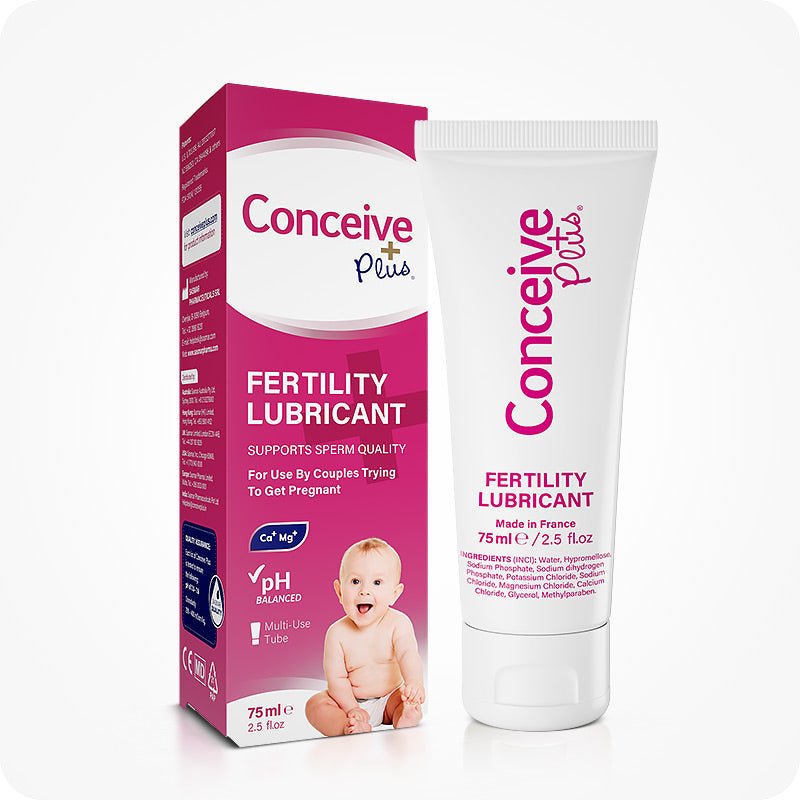
Conceive Plus was formulated to meet all three criteria, making it the most scientifically complete fertility lubricant available.
Conceive Plus vs Pre-Seed: Which Is Better for Clomid Cycles?
Both Conceive Plus and Pre-Seed are marketed as sperm-friendly lubricants, but there are important differences — especially relevant for women on Clomid.
Conceive Plus advantages:
- Contains calcium and magnesium ions that support the sperm capacitation process — an ingredient Pre-Seed lacks
- pH range of 7.2–8.0, optimised for sperm survival and motility
- Isotonic osmolality matched to fertile cervical mucus
- FDA 510(k) cleared as a Class II medical device
- Used in fertility clinics during IUI and IVF procedures as a sperm-safe medium
- Available in both tube and individual applicator formats for internal use
Pre-Seed:
- pH matched for sperm safety
- Does not contain calcium and magnesium ions
- FDA cleared
For women on Clomid, whose cervical mucus is already compromised, the addition of calcium and magnesium ions in Conceive Plus provides an extra layer of support that Pre-Seed cannot match. When your natural cervical mucus is not providing the mineral environment sperm need, your lubricant should compensate. Only Conceive Plus does this.
How to Use Conceive Plus Lubricant on a Clomid Cycle
Using Conceive Plus correctly maximises its effectiveness during your Clomid cycle:
- Track your fertile window: Use an ovulation predictor kit (OPK) alongside or after your Clomid course to identify your LH surge. Clomid is typically taken on days 3–7 or 5–9 of your cycle, with ovulation occurring 5–10 days after the last dose.
- Begin using Conceive Plus during your fertile window: Apply Conceive Plus lubricant internally using the included applicator 5–15 minutes before intercourse, or apply it externally to the vaginal opening and your partner's penis directly before sex.
- Use applicators for internal use: The pre-filled applicators allow you to deposit Conceive Plus directly at the cervix, mimicking the protective environment of fertile cervical mucus. This is especially important when Clomid has suppressed your natural mucus.
- Use consistently: Use Conceive Plus every time you have intercourse during your fertile window — typically the 3–5 days before and including the day of ovulation.
- Avoid washing immediately after: Give sperm time to travel. Avoid bathing or douching for at least 30 minutes after intercourse.
Other Tips to Counteract Clomid's Anti-Estrogen Effects
Beyond using a clomid TTC lubricant safe for sperm, there are additional strategies to maximise your chances on a Clomid cycle:
Stay hydrated: Adequate hydration supports cervical mucus production. Aim for at least 8 glasses of water per day during your cycle.
Evening primrose oil (EPO): Some women find that taking EPO from the start of their cycle through ovulation (not after ovulation) improves cervical mucus quality. Discuss this with your doctor before adding supplements.
Discuss dosage with your doctor: Some fertility specialists will use a lower Clomid dose if cervical mucus quality is severely compromised, or switch to Letrozole (Femara), which has a less pronounced anti-estrogenic effect on cervical mucus.
Monitor with ultrasound: If your clinic offers monitored cycles, follicle tracking ultrasounds can confirm ovulation timing more precisely, helping you time intercourse and lubricant use accurately.
Support with Conceive Plus supplements: Conceive Plus offers fertility vitamins for both women and men that can support egg and sperm quality during treatment cycles. Ask your doctor about supplement compatibility with Clomid.
What the Research Says About Fertility Lubricants and IUI
Many women on Clomid also undergo intrauterine insemination (IUI). An important note: the lubricant you use during the home intercourse phase of your treatment matters just as much as what happens in the clinic.
Research conducted by Maged et al. (2014) evaluated the effect of various lubricants on sperm used in IUI preparation. Lubricants with incorrect pH or osmolality damaged sperm before and after washing. Conceive Plus, by contrast, has been validated in clinical settings as a sperm-safe medium — the same formulation used internally is compatible with assisted reproductive procedures.
In fact, some fertility clinics use Conceive Plus as a preparation medium for IUI and IVF procedures because of its optimal pH and isotonic formulation. Choosing a sperm friendly lubricant clomid users rely on is not just about comfort — it is about preserving every sperm you have.
Frequently Asked Questions
Q: Can I use any lubricant while on Clomid?
A: No. Most standard lubricants (KY Jelly, Astroglide, petroleum-based products, saliva, coconut oil) are toxic to sperm and should be avoided. You should only use a lubricant that is specifically formulated to be sperm-safe, such as Conceive Plus.
Q: Is Conceive Plus safe to use with Clomid?
A: Yes. Conceive Plus is FDA 510(k) cleared and formulated to be non-toxic to sperm. It does not interfere with Clomid or other fertility medications. Always inform your doctor of all supplements and products you are using.
Q: How do I know when to use lubricant on my Clomid cycle?
A: Use Conceive Plus lubricant during every act of intercourse within your fertile window — typically the 3–5 days leading up to and including ovulation. Use OPKs to track your LH surge and time intercourse accordingly.
Q: Does Clomid always cause vaginal dryness?
A: Not always, but it is common. Studies report vaginal dryness or reduced cervical mucus in up to 30% of Clomid users. Some women experience mild effects; others have very noticeable dryness. Using Conceive Plus regardless ensures you are not unintentionally harming sperm motility.
Q: Can I use Conceive Plus with IUI?
A: Yes. Conceive Plus is compatible with IUI and has been used in clinical fertility settings. Use it during home intercourse on the days surrounding your IUI procedure, or as directed by your doctor.
Q: How is Conceive Plus different from Pre-Seed?
A: Both are sperm-safe lubricants, but Conceive Plus contains calcium and magnesium ions that support sperm capacitation — the final activation process needed for fertilisation. Pre-Seed does not contain these ions. This makes Conceive Plus the more complete fertility lubricant for Clomid users.
Q: Is there a lubricant that helps improve cervical mucus?
A: No lubricant can replace or improve your natural cervical mucus — they are two different things. Conceive Plus mimics fertile cervical mucus and provides a protective environment for sperm, but it does not stimulate your body to produce more natural mucus. Discuss cervical mucus quality with your fertility doctor.
Q: Can Conceive Plus lubricant affect my Clomid success rate?
A: Using a sperm-safe lubricant cannot guarantee success, but avoiding sperm-toxic lubricants removes a preventable obstacle. By ensuring sperm are not damaged by the wrong lubricant, you give them the best possible chance of reaching and fertilising an egg on each Clomid cycle.
Q: When should I start using Conceive Plus if I take Clomid on days 3–7?
A: Clomid taken on days 3–7 typically induces ovulation between days 12–17. Begin monitoring with OPKs around day 10. Start using Conceive Plus from the first positive OPK reading through at least 1–2 days after your LH surge.
Q: Is Conceive Plus available in applicator format?
A: Yes. Conceive Plus comes in both a tube with applicators and pre-filled single-use applicators for internal use. The applicator format is particularly beneficial for Clomid users, as it deposits lubricant directly at the cervix, compensating for reduced natural cervical mucus.
The Bottom Line on Lubricant While on Clomid
Clomid is a highly effective fertility medication that gives many couples their best chance at conception — but its anti-estrogenic side effects on cervical mucus and vaginal lubrication are real and meaningful. Using a standard lubricant compounds the problem; using no lubricant when you are dry and uncomfortable reduces intercourse frequency during the vital fertile window.
The solution is straightforward: use a sperm-safe, clinically validated lubricant formulated specifically for couples trying to conceive. Conceive Plus is the only fertility lubricant on the market that combines the correct pH, isotonic osmolality, and sperm-supporting calcium and magnesium ions — everything your natural cervical mucus provides, in a bottle.
Do not let Clomid's side effects undermine your cycle. Choose Conceive Plus as your lubricant while on Clomid and give every sperm the best possible environment to succeed.
Ready to Start Your Fertility Journey?
Discover the full Conceive Plus range — scientifically formulated fertility support for both women and men.
Explore Conceive Plus Products →